In October 2010, the four winners of the Survival Rivals competition (Jessica Woodfield, Charlotte Woodfield, Becky Hill and Eleri Morgan from St Cyres School in Penarth, Wales) together with two of their teachers (Nicholas Alford and Sue Benjamin), two of the competition’s organizers (Amy Sanders of the Wellcome Trust and Amy Turner of Ignite!) and I (Karen James, then a postdoctoral scientist at the Natural History Museum in London) traveled to the Galapagos archipelago for two weeks.

Our aim was not only to enjoy the unique natural environment that inspired Charles Darwin’s theory of evolution by natural selection, but also to capture our experience the way Darwin did. That is, we would record our experiences, ‘specimens’, thoughts, connections and speculations – not using a pen and a red notebook, but Twitter, Flickr and YouTube.

At the end of each day or few days, we would raid our tweets, photos, videos and memory banks and write a short, illustrated blog post (using WordPress). And, at the end of the trip, all of this would serve as our source material for our own version(s) of Darwin’s Journal of Researches (better known now as Voyage of the Beagle), an e-Book to be written and published approximately six months after the trip.

Darwin used layers of increasingly formal writing tools — field notebooks & specimens ➙ diary ➙ book — and so will we, except that our technology will be a little different: Twitter, Flickr and YouTube ➙ Blog ➙ e-Book.

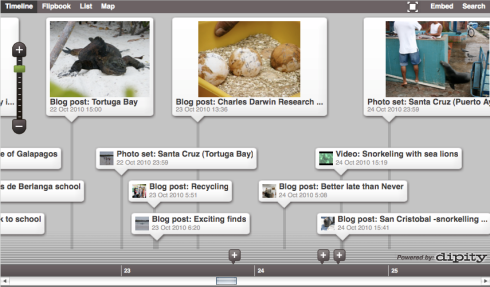
By the end of the trip, we had published a very large volume of primary material: 62 blog posts, 514 Flickr photos and 17 YouTube videos. Concerned about how to represent the strong multimedia component, and inspired by an interactive timeline I had seen in one of Ed Yong’s Not Exactly Rocket Science blog posts, I decided to use Dipity to create an interactive timeline to complement the e-Book.

The e-Book will be available shortly as a downloadable PDF (when it is, I will update this blog post) but the Interactive Timline is ready for your browsing pleasure now:

Note: This is not embedded; it’s just a screenshot. Clicking it will link you away to the timeline on Dipity’s website.

Wow, it feels like forever since I last posted on here. In fact, I was only thinking this morning that we’ve only been home for a month yet it feels like a very distant memory.

Life is back to hectic again (what with school, work, social life etc.) but  lately I keep having little ‘memory bursts’ of how I spent those incredible two weeks. So, this is me finally getting round to doing a summary blog. Here goes:

Most surprising moment: how overwhelming some of our experiences were.

Animal sighting moment: It’s got to be the sea lions. I’ll always remember one tubster flailing around trying to get seaweed off of his back and then attempting to snuggle up to the others which, most of the time, rejected him.

Scariest animal sighting: tortoises of that size are a little bit intimidating when they come huffing up to you (or maybe I think that because I’m short). They weren’t really scary on the whole, they’re  too laid back.

Cutest moment: The sea lion pups

Striking plant life: There was a shrub with pink and orange (my favourite colours) flowers that I haven’t found the name of yet, and I fell in love with the passion pink Hibiscus.

Visually beautiful moment: Tortuga Bay: the most beautiful place on the planet.

Most frustrating moment: All of us being struck down with illness.

Quietest moment: Tortuga Bay lagoon

Most pleasant sound: People saying “Hola” to us in the street. Simple acts of friendliness made us feel welcome (or should that be Wellcome?)

Smelliest moment: Being elbow deep in rubbish at the recyling plant.

Tastiest moment: The fish dishes we had

Most relaxing: Being at the top of the mount in San Cristobal

Most grateful: for everyone that organised it for us, for our teachers believing we had a chance, for Eleri, Charlotte and Jess for providing me with many a-giggle and for the universe for creating such an amazing place.

Funniest moment: The last night when tiredness and ‘going home excitement’ got to us, and left us crying with laughter. Also, like Mr Alford said, watching ‘The Inbetweeners’ in a Galapagos hotel. Terrifically surreal.

Most heart-wrenching: Having to watch everyone suffer with illness. Walking round Santa Cruz knowing that I had to leave.

That was quite difficult to filter off so many memories. As my back garden frosts over (it’s going to reach six degrees on the weekend-time to bring the shorts back out!), it’s hard to block out memories of lying in hammocks, flip-flops being practical footwear and having to take my sunglasses rather than a scarf. I keep remembering explaining to the children at the school that -3 degrees wasn’t a rare occurence here and the shock on their faces as they comprehended such low temperatures. I wish we were still in contact so I could send them a forecast for this week!

2011 is going to have a lot to live up to…

P.S.I’m willing to admit defeat over the “no birds” thing. Maybe I just repel feathered beings.

I posted cards in an official yellow post box in the main street on October 24th, after our final lunch in Puerto Ayora and just before we boarded the boat for Isabela. My guide book had stated that post could take between one and four weeks to be delivered, if at all! I decided to check this out at $2.25 (about £1.50) a time for stamps. Well – the one to my husband has just arrived (still faster than the Beagle’s communications with home I suppose) – the rest of the family are still waiting for their cards!

PPS. Tonight I chatted for a few minutes to the great-great-granddaughter of Charles Darwin – Dr Sarah Darwin (and, I found out, an ex-colleague of Karen’s at the NHM) who was giving a lecture at the National Museum in Cardiff (for Cesagen).  She has just returned from a year long trip in a tea clipper in the wake of Darwin’s Beagle voyage, accompanied by her family and all the personnel required to make a documentary series, The Future of Species, for Dutch TV. Sarah, a geneticist who has researched the evolution of the Galapagos tomato, showed a genuine interest in our trip and praised the achievement of Jess, Eleri, Becky and Charlotte.

…they will come.

After seeing such a different selection of flora and fauna it is easy to forget how wonderful our own native species are.  In response to Becky’s last post about the lack of birdlife on these islands, then I can only refer to “Field of Dreams” – there’s one for your Media Studies!

This slideshow requires JavaScript.

We might be lacking in reptiles on this island, but we make up for them with their relatives, the birds.

Back to Earth with a bump… Getting the day that we got home wrong was a worry.  Luckily when I booked the minibus from Heathrow I was looking at the correct itinerary.  The journey home did not have a great start.  Julio told us that the 5 seater plane that was flying us to Baltra had broken down.  He set off on his bike around the village looking for a captain of a speed boat to take us to the airport.  I suppose we were lucky that the plane broke down before we were due to travel.  It could have done one trip and left half of us stranded on Isabella.

The speed boat journey was an experience.  Our small boat had 2 massive 300HP engines on the back, 50% more power than any of the larger boats that we had been on.  Getting out of the harbour at low tide required the one crew member sitting on the front of the boat to look out for rocks.  Once out the captain gunned the engines and the boat took off, but despite the weight of our cases in the front, the boat was not sitting well in the water so the captain rearranged us to improve the trim and we started out through the swell.  It was a memorable experience riding through the swell at top speed.  Our captain expertly eased the throttle as we crested each wave to smooth the journey.  It was a race against time – the journey should  have taken over 2 hours, which would have made us miss our plane.  We landed on Baltra as our plane was due to leave.  Luckily Julio had already checked us in and warned the airport of our dilemna.  So they held the plane for us.  The rest of the journey was thankfully uneventful and the night time flight allowed us to catch up on some sleep to combat the inevitable jet lag.

It was an incredible experience to visit the islands that have changed the way that we think about life itself.  The closest thing to a pilgrimage that I am likely to make!  I would like to again thank the Wellcome trust for this incredible opportunity, Amy Turner for expertly organising us, Steppes Travel for putting such a wonderful itinerary together and mainly Becky, Charlotte, Eleri and Jess for winning the trip and being such great ambassadours for St Cyres.

So, some moments of reflection:

Most surprising: How emotional I felt on landing on the islands.  Never have I experienced emotion when arriving somewhere new.  It really was a lifetime’s ambition to visit the islands, something that I thought I would have to wait until my retirement to do.  It made me realise how strongly I feel about the importance of Darwin’s discovery about the way that life is.

Favourite animal sightings: The first marine iguana just sitting on the dock when we landed on Floreana, the first fleeting glimpse of a turtle whilst snorkelling off Floreana, the sea lions on San Cristobal beach and in the water, the frigate bird swooping down to take the fish that the young sea lion was playing with, the marine iguanas running away from the dog that ran past on the road, the vermillion flycatcher on the way up to Sierra Negra, seeing so many finches looking just like they do in the text books, shark canal on Las Tintoreras and many, many more.

Most striking plant life: (literally – ducking under the branches of trees whilst riding on the roof of the truck up the bumpy road to the interior of Floreana), else – seeing bromelliads like we used to have in our bathroom growing on trees on Floreana.

Most surreal: Watching the last episode of the Inbetweeners on the other side of the planet with the girls.

Most frustrating: None, life is too short to get frustrated.  Though losing a connection three hours into a four hour video upload in the middle of the night is a trifle annoying.

I’m not really one for lists, apart from my things to do lists which I make each day in school, thankfully they are starting to get shorter again, just about catching up.

I enjoyed my experience of blogging, especially being able to include pictures and the videos.  Very glad to have invested in my MacBook Pro and HD video cameras.  Thanks for all the kind comments.  Final selection of pictures here:

This slideshow requires JavaScript.

I look forward to returning to the islands one day.  The dream of a field trip to the Galapagos is still live.  I wonder how the islands will have changed in 10 or 20 years.  Their evolution due to the selective pressure of increased tourism is inevitable.  The park is incredibly well managed though, and I am sure that the islands will always be a unique place to visit.

We presented to the Governors on Monday night and are ready to start giving assemblies to the different year groups.  The article for the school newsletter has been written and the pictures to accompany it selected.  The girls have been busy with their UCAS personal statements – preparing for their next big adventure.  I’m sitting here in front of the fire, looking out at a winter wonderland – we had about 3” of snow yesterday.  The Galapagos Islands seem a million miles away; however I can close my eyes and picture marine iguanas in an instant and feel the warmth of a tropical sun on my eyelids…

The tortoises really were amazing.  It was so surreal to spot our first one just standing in a field as if it were a cow.  I suppose that’s the niche they fill.  No large mammals made it to the Galapagos, so the few reptiles that did evolved to fill that niche.  We had some wonderful up close moments with these lumbering giants.  It was great watching them eat, which they seem to do most of the time, and occasionally making the effort to put one foot in front of another.  We even heard the sound of tortoise love from the woods and found a mating pair, he had even brought a bunch of flowers for the occasion!

We learnt a lot about how the different shell shapes suited the diet available on the different islands and how their populations had been decimated by the earlier visitors to the islands who used them as a source of fresh meat on long boat voyages before refrigeration.  Apparently a large tortoise could survive in a ship’s hold for a year without food or water.  The same adaptation that had allowed their ancestors to survive the long journey on a raft of logs that brought them to the Galapagos led to their near extinction.  Not only were the tortoises and turtles of the islands a source of meat.  The fats that could be extracted from their bodies were used as lamp oil before the discovery of oil fields in the United States of America.

The name Galapagos comes from the Spanish for the saddle shape that the shells of the tortoises from the drier islands have to allow them to reach leaves from shrubs and trees.  We saw a wide range of shapes on the different islands, including the last remaining Galapagos tortoise from the island of Pinta, the world famous Lonesome George.  George had been removed from Pinta in 1971 and taken to Santa Cruz.  A reward of $10,000 was offered for a female from Pinta, but no females have ever been found.  Attempts to breed Lonesome George with related species have failed.  There have been numerous success stories with the populations of tortoises from other islands and we saw lots of young tortoises up to the age of 5.  Then they can be released into the wild; when their shells are hard enough to resist all predators, native – the Galapagos Hawk, and introduced predators like feral pigs and dogs.

It was great to see the symbol of the Islands now in good health, with populations increasing.  A sure sign that the projects and policies in place, as well as the management of the tourist industry are compatible with unique biodiversity of these special islands.

Video of Sea Lions on shore of San Cristobal (very cute!!)

Our last day on the Islands, a short trip to Los Tintoreras. The sickness is sweeping through us today. Very sparse at breakfast. In the end though, the girls pulled together as a team (again) and through mutual support managed to rally round to make the short trip to Los Tintoreras.

Our small boat was the ideal viewing point for numerous sea lions. Including one that was tossing a fish it had caught in the air, like a cat playing with a mouse. In swept a huge frigate bird in an attempt to grab the fish from the sea lion (unfortunately just before I had switched from the video camera to the still camera!). Anyway, I got one of my favourite shots of the trip of the receding frigate bird looking back over its shoulder and filling the photo.  The final footage of the frigate birds flying below us are actually from San Cristobal – near the statue of Charles Darwin.

We also saw a perched blue footed booby (at last, for me) and another galapagos penguin, staying out of the water to avoid getting its moulting plumage wet.

We moored on Los Tintoreras and saw yet more marine iguanas as well as many sea lions, young and old. We discovered that sea lion poo is very similar to dog poo, but paler and that on occasion marine iguanas have been seen eating it – yeuch, dropping points there guys – you might not be my favourite animal if I keep hearing of things like that! Read the rest of this entry »

We can’t believe that it’s nearly a week since we left Guayaquil and said goodbye to Ecuador!

Our minds were full of stories to tell our friends and family when we arrived back home. But that had to be put on hold until our body clocks were back to their usual selves. The clocks going back didn’t help!

So, we’re going to take a leaf out of Mrs B’s book and create our own post of reflection. ^^

Most surprising moment: How beautiful Quito was. We love Quito!

Animal sighting moment: Galapagos Hawk

Scariest animal sighting: Huge paper wasps

Cutest moment: Javier <3  jokes.. All the children at the school

Striking plant life: Passionflowers

Visually beautiful moment: At the top of Sierra Negra volcano

Most frustrating moment: Not being able to skype and all of the plane delays we had

Quietest moment: Looking over the Chico volcano

Most pleasant sound: The Sound of Silence (The band which followed us)

Smelliest moment: Our Bathroom in Isabella

Tastiest moment: The Rock Restaurant, Santa Cruz and Pims, Quito

Most relaxing: Lazing by the pool in Santa Cruz

Most grateful: For the trip itself and kindness of all our guides, staff and of course the Wellcome Trust and Ignite Futures

Funniest moment: Lettuce.

Most heart-wrenching: Eleri being ill and nothing that we could do for her

Now don’t think us odd when you read this; Ecuadorian’s have the best aftershve. No joke.

Since us girls arrived home, it’s popped up in all of our conversatiions. We ourselves are not sure why. It’s just good. Fact. :D

Once again we would like to thank everyone involved with the trip and all the friends we made along the way! A special thanks to Amy Turner for putting up with our illness’s and Jess’s frequent gun shows which she can have tickets for anytime!

Please keep in touch!

Charlotte and Jess!

Mon Nov 1st

I’m home and back down on Earth, my mind being disconnected from my body  for the last 2 days. I’ve unpacked, filled the washing machine a few times, caught up with family (life-changing events have happened here too!), washed the lava dust from my walking socks, slept and regained my appetite. I’ve eaten the Marmite sandwich I craved for. I’ve hung the woven wall hanging of Galapagos animals bought as a souvenir.

The return journey was quite an adventure in itself – a rapid 2-hour plus speed boat ride between islands; three plane journeys; elevators, an underground train ride and power walking between terminals at Madrid; and finally a remarkably quick and easy minibus ride from Heathrow to home. We had a short stop in Guayaquil, long enough to be taken through the busy traffic to the modern riverfront development where we were able to grab a drink in a fast food outlet. What a contrast to Isabela – Julio, our guide, had told me that young people from the Galapagos migrating to the Equador mainland have problems adjusting and often move back – no wonder.  (In this city, when you park on the roadside, your car is lifted and pushed, nose to tail with the car in front. If the car in front is still there when you wish to leave, the cars ahead are pushed forward until you have room to manoeuvre out.)

So, some moments of reflection: Read the rest of this entry »

Follow

Get every new post delivered to your Inbox.